
Oct 27, 2026Chain Operations
Knife Anatomy for Buyers: Bolster, Tang, Heel and the Balance Point
A knife is a system of parts with names buyers should know — bolster, tang, heel, spine, choil — plus the five handling checks that reveal quality.
Knife Anatomy for Buyers: Bolster, Tang, Heel and the Balance Point
Hand a professional cook a knife and they will name its parts before they cut anything: where the bolster sits, whether the tang runs full, where it balances on a finger. That vocabulary is not showmanship — it is how the tool's construction, and its price, become legible. A buyer who reads a knife the same way stops paying for the wrong features and starts specifying the right ones.
This guide maps the anatomy, the construction decisions behind each part, and the handling checks that take five minutes at a counter and predict years of service.
The Blade Map
Tip and point. The forward working end — precision work, scoring, shallots. Tip geometry determines whether the knife draws clean curves or fights them. Damaged tips (the most common kitchen-knife injury after edge dulling) usually mean the knife has been dropped or used as a pry bar — a training signal, not a warranty one.
Edge. The sharpened bevel doing the cutting. Edge angle and steel hardness together define sharpness and retention — the interplay covered in our steel grades guide. For the buyer, the edge questions are consistency (a uniform grind along the whole length) and the steel's verified hardness, because an unverified hardness claim means an unverified edge-life promise.
Spine. The blunt top of the blade. Thickness here is the stiffness budget: a thicker spine flexes less in hard cuts; a thinner spine makes the knife feel quicker. On quality knives the spine is finished — softened edges, no burrs — because cooks rest fingers on it.
Heel. The rear section of the edge, near the handle, where leverage cuts happen — splitting squash, chopping through joints. Heel geometry is where cheap knives reveal themselves: insufficient height at the heel means knuckles hit the board on every full cut.
Choil. The notch where heel meets handle. A shaped choil lets a sharpening stone reach the entire edge; an absent one leaves a dead zone at the heel that no maintenance recovers. On forged knives, the choil is part of the bolster shaping.
The Handle Junction: Where Knives Live or Die
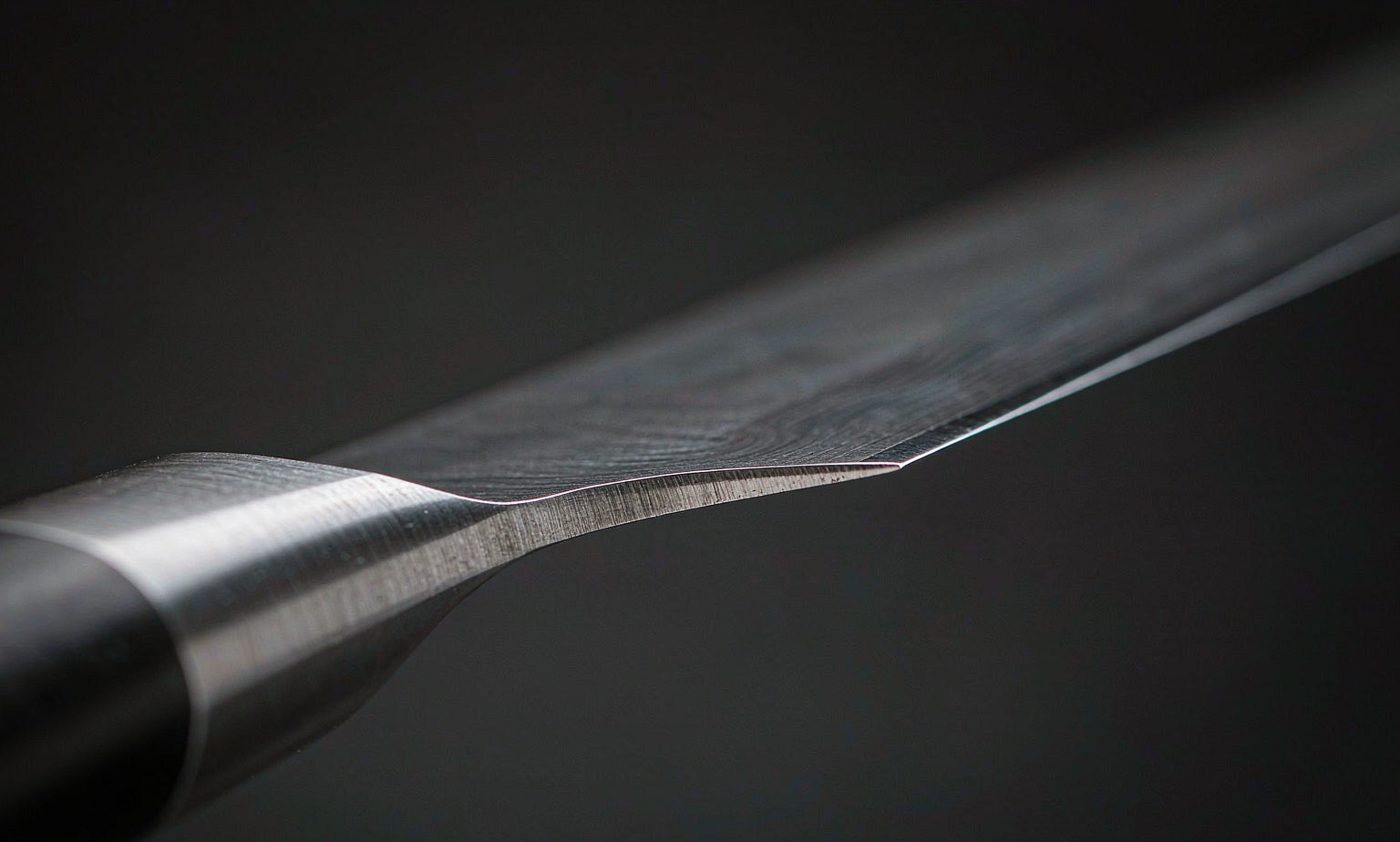
Bolster. The thickened junction between blade and handle — the signature of forged construction. The bolster adds mass exactly where it sets the balance point, protects the hand from the heel, and stiffens the junction. Stamped knives can carry a simulated bolster (a shaped collar); the difference is mass and balance, visible in the handling checks below.
Tang. The steel continuing from the blade into the handle. Construction tiers:
Construction | What it means | Service implications |
|---|---|---|
Full tang | Steel runs the handle's full length and width | Maximum strength; the junction cannot fail under normal use |
Partial/hidden tang | Steel narrows inside the handle scales | Lighter; acceptable for light-duty formats |
Rat-tail tang | A thin rod into a cast handle | The classic failure point — bending and separation under leverage |
Molded-around | Handle polymer molded over a stub | Economy tier; suited to low-cost, replaceable programs |
For chain kitchens, the tang question is a total-cost question: full-tang knives cost more and survive abuse cycles that retire their economy cousins — the arithmetic our knife maintenance guide develops with replacement logs.
Scales and handles. The grip surfaces — riveted polymer, composite, or molded elastomer. The buyer's checks are seam quality (a seam collects soil and fails in the dish room), rivet finish (flush and polished), and slip behavior when wet. Wooden handles carry warmth and tradition; commercial reality assigns them to hand-wash programs — the same wash-discipline decision as lacquered chopsticks.
The Balance Point
Balance is the anatomy assembled into behavior. Where a knife balances — at the bolster, forward of it, or back at the handle — decides how it feels after four hundred cuts. Forward balance drives the knife through cuts (workhorse logic); handle balance favors agility and precision formats.
The test is the finger balance: balance the knife on one finger at the bolster. A chef's knife balanced at or just behind the bolster handles most kitchen work without fatigue. There is no universally correct point — there are correct points per format, which is why professional lines balance differently per knife type.
The Five Handling Checks
At a counter, with a sample in hand:
1. Balance on a finger at the bolster. Note where it sits; compare against the format's intent. 2. Knuckle clearance: simulated cut flat to a board. Fingers must clear. Fail here disqualifies regardless of price. 3. Spine and choil feel: run a thumb along the spine and the choil. Burrs and sharp shoulders are finish failures that predict carelessness elsewhere. 4. Heel height: look at the blade height at the heel against your knuckles. Tall enough heels are the difference between full-arc cutting and chopping around your own hand. 5. Junction rigidity: grip the blade (dry hands, behind the edge) and check for any movement at the handle junction. Any movement at all is a failing knife, whatever the spec sheet claims.
These five checks, run across a supplier's samples, separate construction tiers faster than any catalog copy — and they are exactly what the batch quality control should repeat at receiving, because construction consistency is a production discipline, not a design one.
Specifying at Program Scale
The specification that survives writes the anatomy into line items: full tang or justified alternative, handle material and wash rating, spine and choil finish, heel height class per format, balance intent — plus the verified hardness that underwrites the edge. Our commercial knife program specifies and verifies HRC 52 per production batch for exactly this reason: anatomy makes a knife usable, and verified steel makes it usable for years.
Frequently Asked Questions
Is a bolster always better? It adds mass, balance control and hand protection at a cost premium. Stamped knives without bolsters remain legitimate light-format tools — the bolster is a feature to specify where its benefits apply, not a universal badge of quality.
What actually fails first on cheap knives? In order: the edge (unverified hardness), the handle junction (rat-tail tangs), then the edge again (uneven grinds that no maintenance schedule recovers).
Can you feel the difference between tang constructions? At rest, sometimes; at work, always — the junction is where leverage loads concentrate, and a hidden-tang knife communicates it through flex and, eventually, failure.
Do rivets matter? Flush, polished rivets signal assembly care and protect the dish room; raised rivets collect soil and scratch racks — a small finish detail with daily consequences.
Why specify balance intent per format? Because a balanced chef's knife and a balanced paring knife are balanced differently on purpose. One balance number for the whole line is a specification written by someone who never cooked.

